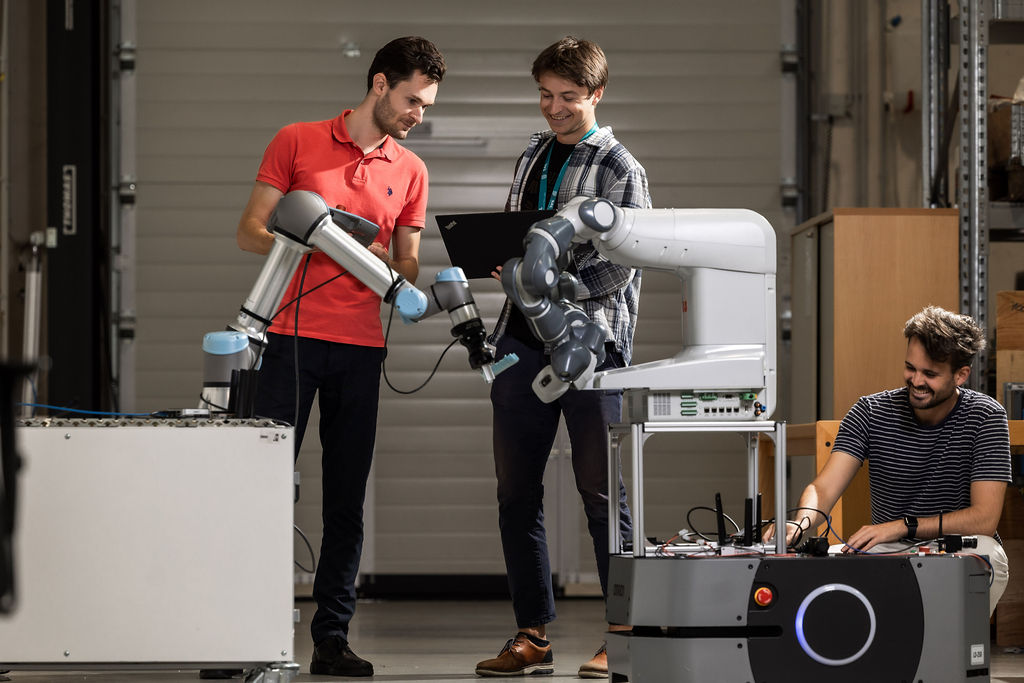
The Embedded AI Research Unit develops energy- and computationally-efficient AI for industrial and IoT systems, with a focus on robustness, reliability, and real-world applications.
Our research combines classical signal processing, domain expertise, and modern machine learning to develop embedded AI solutions that are more efficient, more reliable, and more interpretable than purely data-driven approaches. We are convinced that hybrid AI methods, which explicitly integrate prior information and physical knowledge, are essential for dealing with measurement uncertainties, hardware limitations, and environmental variations typical of industrial applications.
A defining feature of our work is the close integration between AI models and hardware. We take a hardware-software co-design approach in which learning algorithms, model architectures, and hardware platforms are developed in tandem to achieve optimal performance, latency, and energy efficiency on embedded systems.
A key part of our work is the development of:
- Feature engineering and exploratory data analysis as key prerequisites for efficient, interpretable, and data-centric embedded AI
- Anomaly detection and identification with limited data availability and strict requirements for minimizing false alarms, to enable reliable operation in industrial and safety-critical environments
- Open-set recognition and reject-option methods that enable embedded AI systems to safely handle unknown or unforeseen situations
- Integrating prior knowledge—such as physical models, system constraints, and expert insights—into learning algorithms to reduce data requirements and improve generalization ability
- Multimodal signal processing and sensor fusion covering image, audio, laser, network, and other sensor data
- Physics-inspired and physics-informed neural networks that directly incorporate physical principles into model architectures or training processes to improve robustness, efficiency, and explainability
- Energy-efficient embedded real-time AI, developed through close hardware-software integration, including approaches inspired by biological information processing using spiking neural networks