E-bikes are an important building block for the (inner-city) mobility of the future. However, they are more expensive and less environmentally friendly than a conventional bicycle, considering the emissions required to produce the battery needed and the carbon footprint for energy consumption during the ride, the latter depending on the electricity mix used. In practice, battery life limits the usage time of the complete vehicle. The recycling of used batteries from electric vehicles is a general problem that is rapidly gaining in relevance.
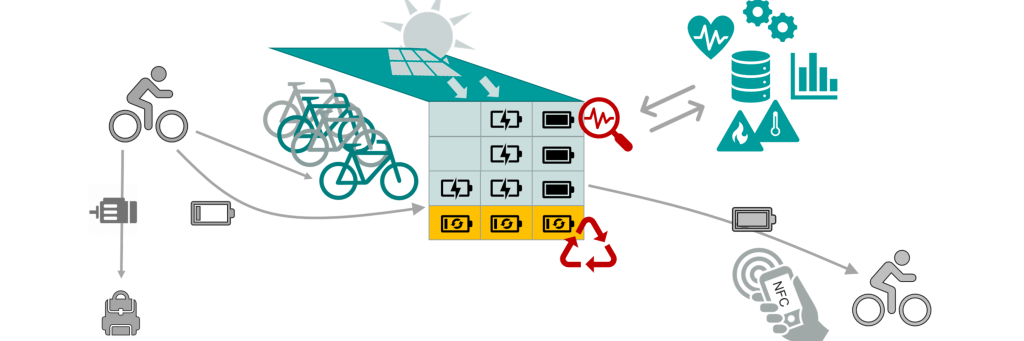
One promising approach to promote e-bikes for commuter traffic is battery sharing, i.e. battery-as-a-service (BaaS). The bat2share project investigates to what extent controlled charging processes, optimal storage and cycling can maximize battery usage intensity, extend its lifetime and reduce the number of e-bike batteries in circulation.
Within the framework of industrial research, the aim of this project is to investigate and develop the components of such an e-bike battery sharing system and to bring them together in the form of a laboratory demonstrator. This includes
- an intelligent battery management system (BMS) with state of health (SoH) monitoring, integrated in the e-bike battery, the power electronics, control algorithm and energy management concept to charge and monitor a large number of batteries simultaneously in an energy-efficient way, thermal conditioning, access system for user identification,
- the software framework for operators, users and automated battery health management, i.e. user and battery data acquisition and processing,
- the development of a gamification and incentive scheme for user motivation and awareness generation for carbon footprint and the economic good "battery",
- the investigation of scalability and applicability for commuter traffic, also with regard to grid-friendly charging.
The sharing & charging station is to be operated self-sufficiently by means of photovoltaics (PV). Second-life e-bike batteries from the same sharing system will serve as stationary storage. In contrast to existing rental vehicles and battery-sharing concepts, the system is based on an e-bike retrofit kit. Hence, potentially any conventional bicycle can be electrified and powered by a shared battery. This eliminates the need to provide additional or special vehicles (like e-scooters) for sharing and also solves the "last mile" issue, as users can use their own bicycle as usual, even without batteries.
Research program
This research project is funded by the Zero Emission Mobility program of the Climate- and Energy funds owned by the Republic of Austria, operated by the Federal Ministry for Climate Action, Environment, Energy, Mobility, Innovation and Technology.