Collaboration

Partnerships for research, development, and technology transfer – from collaborative projects to tailored innovation solutions.

About SAL

Insights into SAL’s mission, values, research activities, and contribution to Europe’s innovation ecosystem.

KERMIT

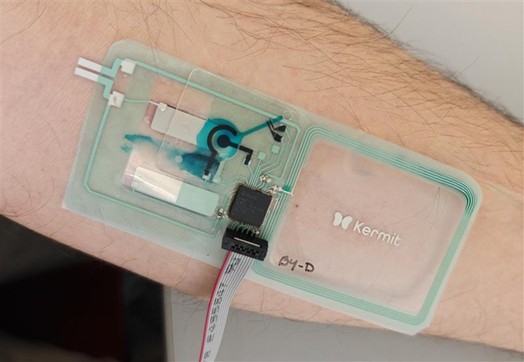
KERMIT is developing a wearable sweat sensing patch for early detection and remote assessment of kidney disease. The project integrates printed electrochemical sensors, sweat stimulation, microfluidics, low power electronics and wireless communication into a soft patch platform.

Project goals

KERMIT aims to create a new generation of non-invasive diagnostic tools for kidney disease by using sweat as an accessible biofluid. Instead of relying on conventional blood or urine testing, the project explores how wearable technologies can support earlier screening, easier follow-up and more patient friendly testing.

The main objectives are:

  • Develop printed electrochemical sensors for kidney disease related biomarkers, including creatinine, cystatin C and urea.
  • Integrate sweat stimulation using screen printed iontophoresis electrodes and transdermal cholinergic agents
  • Route sweat through a thin microfluidic layer toward dedicated sensing areas.
  • Combine the sensing system with low power electronics, an antenna and smartphone-based readout.
  • Validate the patch concept using clinically relevant samples and patient testing workflows.
  • Improve the sustainability of wearable medical devices through bio-based recyclable or lower impact materials.
  • Establish a device architecture that can support future point of care and remote health applications.

In simple terms, KERMIT is trying to answer a very practical question: can we make kidney function testing easier, softer and closer to the patient?

Project Consortium

A European consortium combining expertise in printed electronics, biosensors, clinical validation, microfluidics, semiconductor technologies and sustainable wearable systems. Silicon Austria Labs is coordinating the project and contributes to the development and integration of printed and flexible electronic components for the KERMIT patch, including printed sensor platforms, device integration, microfluidic interfacing and sustainable materials concepts for wearable healthcare devices.

Project
facts

Title: Kidney Disease Sweat Sensor Patch for Early Diagnosis and Remote Monitoring
Acronym: KERMIT
Grant agreement number: 101115504
Program: Horizon Europe
Funding agency: European Commission
Funding program: Research and innovation project funded by Horizon Europe
Project duration: Official start date until July 1, 2023. The project has been extended until October 31, 2026.
Project Manager / Coordinator Dr. Daniel Corzo, Silicon Austria Labs

A wearable sweat patch for kidney disease screening

As part of the KERMIT project, a soft, wearable skin patch was developed for the non-invasive early detection of kidney disease, using sweat as a diagnostic fluid. The platform combines printed sensors, microfluidics, low-power electronics, and wireless data readout in a compact system. KERMIT thus enables easily accessible early detection and remote monitoring of kidney function based on key biomarkers such as creatinine, cystatin C, and urea—while prioritizing comfort and sustainability.

Similar Projects

Discover more projects with similar focuses and technologies.

FIRESAT

The project „FIRESAT“ investigates the challenges and benefits of using artificial intelligence (AI) for on-board processing directly on Earth observation satellites. The ESA mission „OPSSAT,“ as well as OroraTech's dedicated CubeSAT platform, will be used for in-flight experiments to demonstrate the feasibility of the use case – satellite-based forest fire detection using on-board AI analysis of live RGB images....

ISOLDE

The ISOLDE project aims to expand, further develop, and industrialize the European RISC-V ecosystem. RISC-V is an instruction set architecture based on the design principle of Reduced Instruction Set Computer (RISC). The project aims to leverage the open-source community to enhance the security of the RISC-V architecture and make the system more robust against attackers...

NanoMacs

Within the „NanoMacs“ project, nanocrystalline magnetic materials are to be used instead of conventional (ferrite) materials for various electromagnetic components in order to improve the performance of power converters in terms of efficiency and power density….

Contact

Business Development
Mag. Veneta Ivanova
Business Development Sensor Systems
Villach
Project Manager
Dr. Daniel Alejandro Corzo Diaz
Senior Scientist, Advanced Sensors & Electronics Technologies
Villach

Newsletter

Our Science & Stories newsletter provides the latest news, bietet aktuelle Neuigkeiten, Forschungshighlights und spannende Einblicke
von Silicon Austria Labs – direkt ins Postfach.