
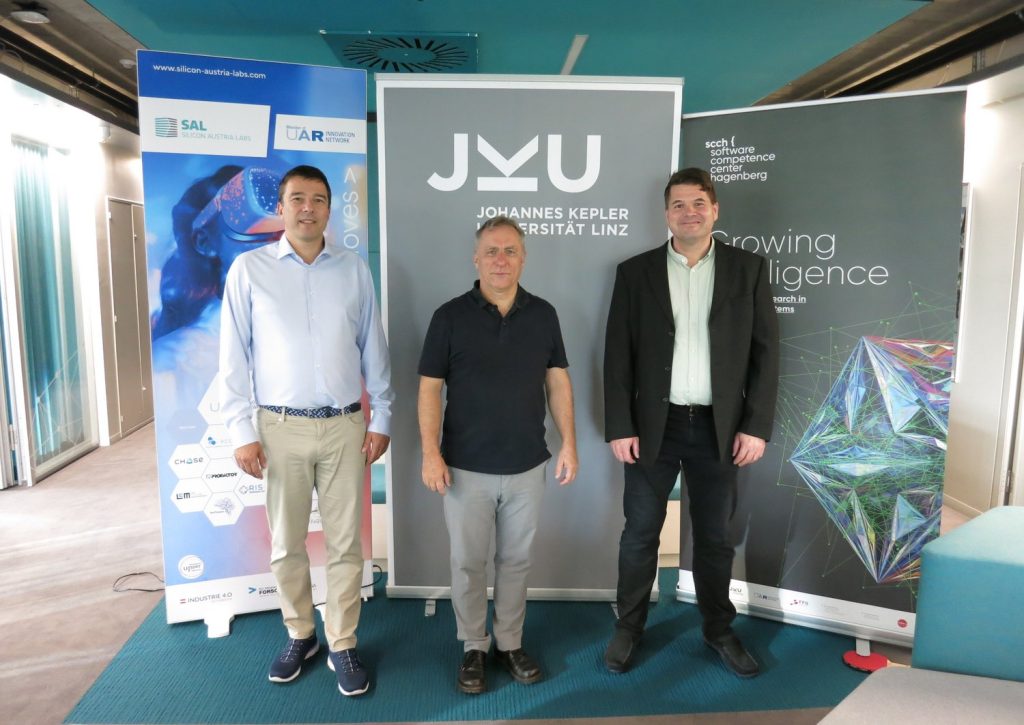
Neuromorphic Computing is an emerging technology designed to make artificial intelligence (AI) faster and more energy-efficient. For the past three years, the Institute for Signal Processing at Johannes Kepler University Linz (JKU), Silicon Austria Labs (SAL), and the Software Competence Center Hagenberg (SCCH) have been working closely together, pooling their expertise to advance this exciting field.
Neuromorphic Computing – Inspired by the Brain
Unlike classical computers, which process information in bits, the human brain uses short electrical impulses—known as spikes. What matters is the precise timing of these spikes, which carries the actual information.
This timing-based representation allows the brain to transmit more complex information per signal compared to a digital bit, which can only be “0” or “1.” The intervals between spikes and their patterns carry additional meaning, making this highly efficient for tasks such as detecting patterns or sequences in real time. In technology, these principles are replicated by so-called Spiking Neural Networks (SNNs).
“Our goal is to develop systems that mimic biological structures and processes—using minimal energy while achieving maximum responsiveness,” explains Priv.-Doz. Dr. Bernhard A. Moser, Technology and Innovation Manager at SCCH. “Potential applications include robotics, medical technology, and environmental monitoring.”
Dispelling Common Myths
Despite growing interest, several misconceptions about Neuromorphic Computing (NC) persist—such as the assumption that it requires expensive, specialized hardware, is slower than traditional methods, or lacks industrial maturity. “We show that many of these assumptions are outdated,” says Dr. Thomas Buchegger, Head of the SAL site in Linz. “NC offers tremendous potential not only in energy efficiency but also in speed. Moreover, it can be effectively implemented on standard hardware platforms—not just specialized analog chips.”
A recent joint study by JKU, SAL, SCCH, and TU Graz has demonstrated NC’s versatility in the medical field. Researchers found a way to collect and process electrocardiogram (ECG) data far more efficiently—reducing data volume by more than 80% without sacrificing analysis quality. This means lower storage requirements while maintaining the same accuracy, opening up significant opportunities for the future of medical diagnostics and beyond.
Milestones of the Research Partnership
Since the beginning of their collaboration, the partners have achieved a number of pioneering successes that impressively underscore the international potential of neuromorphic computing „Made in Austria“:
World Record for SNN Inference on Standard FPGAs
Using a newly developed demonstrator, the team has shown that Spiking Neural Networks can run at exceptional speeds on widely available FPGA (Field Programmable Gate Array) systems.
“Our method processes over 2.5 million images per second—more than 100 times faster than previous systems using the same hardware and data,” says Assoc. Prof. Dr. Michael Lunglmayr from JKU’s Institute for Signal Processing. “It also operates at low power, achieving more than 3 million images per second per watt.”
This breakthrough illustrates how modern AI can be both highly powerful and energy-efficient—on off-the-shelf hardware.
Patent Filed
The team has filed a patent for a novel, ultra-energy-efficient data acquisition method based on neuromorphic principles inspired by the human brain.
Austrian Workshop Series and Publications
Through the SNNSys workshop series on Neuromorphic Computing and Spiking Neural Networks, organized in collaboration with TU Graz as part of the AIROV conference, the partners are driving knowledge exchange within Austria’s research community. Findings have been published in leading journals such as the Journal of Neuromorphic Computing and Engineering and presented at top-tier conferences, including the IEEE International Symposium on Circuits and Systems.
International Grand Challenge
In September 2025, at the prestigious IEEE International Conference on Image Processing (ICIP) in Alaska, the research team will host an international challenge under its motto “Low Energy, High Speed.” The competition aims to identify the most efficient and fastest AI solutions.
“We’re excited to see the creative and innovative approaches this will inspire,” says Moser. “The strong interest from the scientific community shows the incredible momentum in this field.”
About the research partners
Software Competence Center Hagenberg (SCCH)
Software Competence Center Hagenberg (SCCH) is a leading non-university research center in Austria, specializing for over 20 years in applied research in the fields of Data Science and Software Science. SCCH excels in project implementation for digitalization, Industry 4.0, and Artificial Intelligence, serving as an interface between international research and domestic industry. The center employs around 130 staff from 25 nations, conducting world-class research. As a COMET Center (Competence Centers for Excellent Technologies), SCCH is funded by the Austrian Federal Ministry for Transport, Innovation and Technology, the Federal Ministry for Digitalization and Business Location, and the State of Upper Austria.
Press contacts:
- Mag. Martina Höller, Science Communication, Software Competence Center Hagenberg, (+43) 50 343 882, martina.hoeller@scch.at
- Priv.-Doz. Dr. Bernhard A. Moser, Technology and Innovation Manager at SCCH and co-initiator of this cooperation, also works with a double affiliation at the Institute for Signal Processing at Johannes Kepler University Linz (JKU). bernhard.moser@scch.at
Johannes Kepler University Linz (JKU) – Institute for Signal Processing (ISP)
The Institute for Signal Processing (ISP) at Johannes Kepler University Linz is a leading academic research unit specializing in the algorithmic, architectural, and hardware-oriented aspects of signal processing systems. Its research spans information and communication systems, high-frequency and baseband integrated circuits (ICs), bio- and sensor signal processing, and automotive applications.
For nearly 60 years, the Johannes Kepler University has been rooted in regional tradition but endowed with a strong international perspective. As Upper Austria’s largest institution of education and research, the university offers degree programs and conducts research in the fields of law, engineering, natural sciences, medicine, education, social sciences, economics and business. The JKU campus is home to approximately 25,000 enrolled students and close to 4,000 employees, boasting a modern infrastructure with ample space to study, learn, conduct research, and enjoy university life.
Press contacts:
- Mag. Christian Savoy, University Communications, +43 732 2468 3012, christian.savoy@jku.at
- Associate Professor Dr. Michael Lunglmayr, co-initiator of the cooperation,
- Michael.lunglmayr@jku.at
Silicon Austria Labs (SAL)
Silicon Austria Labs (SAL) is Austria's top research center for electronics and software-based systems (ESBS), which are the technological backbone of digitization. At three locations in Graz, Villach and Linz, SAL conducts cutting-edge research in Microsystems, Sensor Systems, Power Electronics, Intelligent Wireless Systems, and Embedded Systems to develop future-oriented solutions for industrial production, health, energy, mobility, and safety.
The Intelligent Wireless Systems division focuses on developing reliable and secure communication systems for industrial environments. This enables broadband connections for mobile devices (e.g., smartphones, tablets, laptops), wireless machine-to-machine communication, and increasingly wireless sensor networks in industrial applications.
One of SAL’s flagship initiatives is Digineuron, a pioneering project aimed at developing ultra-efficient integrated circuits that implement AI in miniature formats. These chips mimic the structure and function of the human brain, using layered neural networks that communicate locally to minimize energy consumption — opening new possibilities for smart, low-power applications.
SAL brings together key players from industry, science, and research, combining valuable expertise and know-how to conduct cooperative, application-oriented research along the value chain. Cooperative projects are co-financed by SAL and enable a fast and unbureaucratic project start.
Press contacts:
- DI Dr. Thomas Buchegger, thomas.buchegger@silicon-austria.com